The research behind Imprint
You feel it when your toddler shares a toy on the playground, when they finally conquer that impossible puzzle before bedtime, or when they reach for your hand during bath time. Instinct tells you these tiny milestones are building something bigger.
Science confirms it.
125+ peer-reviewed studies across 25 core traits. We cite our sources so you can check our work.
What builds a confident child?
Confidence and capability aren't born — they're built in the early years through patience, curiosity, and connection.
Being a good friend today shapes their tomorrow.
Children who develop strong social skills in kindergarten are 54% more likely to earn a high school diploma and twice as likely to attend college.
Jones et al., 2015
Self-control in childhood shapes the rest of their life.
A landmark 32-year study following 1,000 children found that childhood self-control predicts physical health, financial stability, and reduced substance dependence in adulthood — independent of IQ or family wealth.
Moffitt et al., 2011
A curious mind levels the playing field.
When kindergartners are encouraged to ask ‘why’ and explore, they perform just as well in math and reading as peers from higher-income backgrounds.
Shah et al., 2018
Focus is the foundation of achievement.
A preschooler’s ability to pay attention when they first enter school remains one of the strongest predictors of their future academic success.
Duncan et al., 2007
Trying again matters more than getting it right.
Children who are encouraged to persevere through frustration are significantly more likely to persist through challenging tasks and achieve long-term goals.
Duckworth et al., 2007
What builds a happy child?
Happiness isn't a fleeting mood. It's a set of emotional tools your child can learn, practice, and carry into adulthood.
Bouncing back from scraped knees builds mental health.
Adults who developed high resilience during childhood experience a 65% lower risk of anxiety and depression later in life.
Masten & Motti-Stefanidi, 2020
‘Thank you’ rewires the brain for joy.
Practicing gratitude isn’t just polite — adults who regularly express thankfulness experience a 15% increase in overall life satisfaction.
Emmons & McCullough, 2003
Understanding feelings unlocks potential.
Children who learn to navigate their own emotions — and recognize them in others — experience significantly better psychological well-being and academic performance.
Brackett et al., 2011
Moving the body builds the mind.
Physical play doesn’t just burn off toddler energy. Children engaged in active play see measurable improvements in both fitness and cognitive development.
Hao et al., 2023
What builds a close family?
The bond you're building right now is the blueprint for every relationship your child will ever have. It starts with you.
Holding them close now keeps them close later.
Securely attached children are significantly more likely to maintain strong, close relationships with their parents when they become adults.
Sroufe et al., 2005; based on Ainsworth et al., 1978
How you talk matters more than how much.
The warmth and quality of your daily conversations does more for your child’s language development than simply hearing a high volume of words.
Hirsh-Pasek et al., 2015
Doing things together transforms how you connect.
Families who regularly engage in shared activities experience 30% better communication and a deeper emotional connection.
Orthner & Mancini, 1991
Letting them grow helps them love better.
When parents actively support their child’s independence, those children grow into adults who report significantly higher relationship satisfaction.
Ryan & Deci, 2000
From peer-reviewed studies to your Tuesday afternoon
You don't have time to read academic journals. You have 15 minutes before bedtime. Here's how we turn decades of research into moments you can share today.
The Study
We continuously review the gold standard of childhood development literature, isolating the specific behaviors that lead to lifelong well-being.
The Trait
We map these findings to 25 core traits — like Resilience, Gratitude, and Curiosity — giving us a clear, actionable picture of what to nurture.
The Moment
We design simple, joyful activities that fit into your existing day. No prep, no materials — just you and your child building a vital skill together.
What it looks like in your pocket
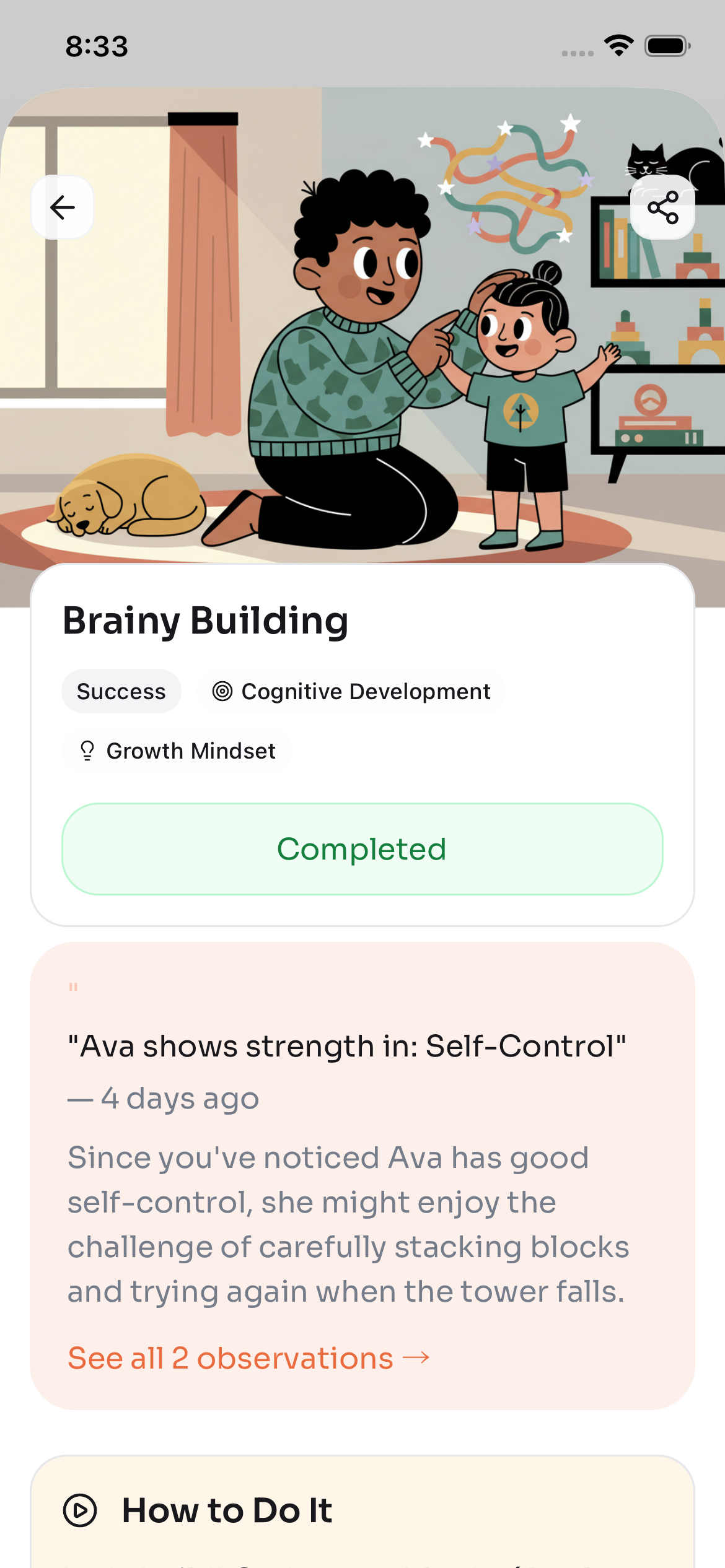
Our research foundations
We don't chase trends. We rely on decades of peer-reviewed evidence.
Character Strengths & Personality Science
Drawing from the Big Five, Duckworth's Grit research, and Dweck's Growth Mindset — the traits that predict lifelong achievement, from curiosity to conscientiousness.
Attachment Theory
The foundational science of how early, responsive relationships shape your child's brain and their capacity for lifelong connection.
Positive Psychology
The science of human flourishing, focusing on the measurable benefits of gratitude, resilience, and purpose.
Cognitive Development
The study of how young minds develop executive function — the focus, self-control, and flexibility needed to navigate the world.
A note on our sources: The research we cite was predominantly conducted on Western populations. We acknowledge this limitation and are committed to broadening our evidence base. Correlation is not causation — but decades of converging evidence gives us confidence in these patterns.
The moments are already there. Let's make them matter.
You have everything you need to give your child the best possible start.
Science-backed. Private by design. No spam.